


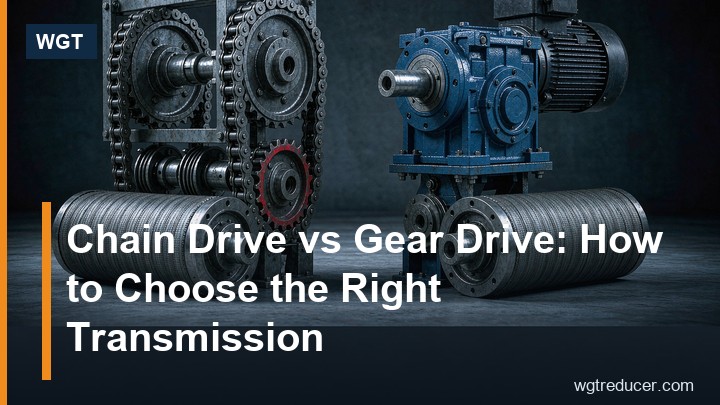
Chain Drive vs Gear Drive: How to Choose the Right Transmission
Both chains and gears move torque from a driving shaft to a driven one, and in a workshop either one will make the machine run. The differences show up in the details: how fast each can turn, how much ratio one stage can carry, what the drive costs in energy over a year, how it behaves in dust and washdown, and what maintenance it demands to reach the life it was sold with. A chain drive is an open, tension-based system that wears visibly; a gear drive is a closed, oil-lubricated contact system that hides its condition inside a housing. Choosing between them is mostly a matter of speed, ratio, environment and who will maintain it.
This comparison works through both technologies the way a drive selection actually happens: where each one wins, the numbers side by side, the speed and ratio ceilings, the efficiency and what it does to the electricity bill, wear and maintenance over the years, and a short decision method you can apply to a specific machine.
Where Chain Drives Still Win
A roller chain and two sprockets are the cheapest way to transmit moderate power between two shafts a metre or more apart. The parts are commodity items, stocked by every distributor, and replacing a stretched chain and two worn sprockets takes an hour with hand tools - no alignment machine, no oil drain, no lifting gear. For a machine that runs occasionally, sits in a dry shed, and was priced to sell, that economy is decisive.
Chains also tolerate a layout a gearbox cannot. The centres can be long, the shafts can be far apart, and one chain can drive two or three sprockets at once with simple timing relationships, which is why packaging machines and small conveying lines still use them everywhere. A chain is forgiving of small centre-distance errors because it stretches into position; a gear set is not forgiving of anything.
There is one more honest advantage: a chain drive shows its wear. Elongation beyond about 1.5 to 2 percent of pitch length is visible with a rule, and the correct response - replace before the sprockets hook - is cheap. A gearbox that is quietly losing tooth profile gives far less warning.
Where Gear Drives Win
A sealed gear reducer does three things no open chain can. It carries high ratios in one compact stage - a helical pair handles 6:1 comfortably, a worm set handles 60:1 or more where a chain drive would need three or four stages of sprockets and guards to do the same job. It runs quiet, because the tooth contact is inside an oil-filled housing rather than metal on metal in open air. And it is protected: dust, washdown water and weather reach a gearbox only as far as its seals, while they work directly on an exposed chain every hour.
The torque density difference is the one that ends most arguments. A gearbox that fits in the space of a shoebox carries what a four-stage chain drive with three idler shafts and a chain guard the size of a door would need. On a conveyor head shaft or a mixer drive, that difference decides the layout.
Gear drives also hold their efficiency for years, because the oil film protects the tooth surfaces; a chain drive loses efficiency gradually as the chain elongates, the sprockets wear, and the tension has to be retightened. For a selection that has to be right for a decade rather than a season, the sealed system usually wins. The shaft-mounted industrial gearbox page shows the compact end of this argument: the whole reduction hangs directly on the conveyor pulley shaft, where a chain drive would need a base, a guard and a tensioner.
Head-to-Head Comparison
| Criterion | Roller chain drive | Sealed gear drive |
|---|---|---|
| Typical single-stage ratio | 1:1 to 7:1 | Helical up to ~6:1; worm to 60:1+ |
| Practical ratio at 24:1 | 2-3 chain stages | One helical unit (2-3 internal stages) |
| Pitch-line / chain speed | Comfortable to ~15 m/s; less at high load | Helical gears well above 30 m/s |
| Efficiency, whole drive | ~96% per stage, drops as chain wears | ~95-98% total, stable over life |
| Power range | Best below ~100 kW | From fractional kW to megawatts |
| Lubrication | Manual, drip or bath, exposed | Oil bath or forced, sealed |
| Environment tolerance | Suffers in dust, washdown, weather | Protected by housing and seals |
| Noise | Audible chain whine, grows with wear | Low, set by gear quality |
| Wear indicator | Visible elongation, easy to check | Hidden; vibration and oil analysis |
| Replacement | Chain + sprockets, hand tools, minutes | Whole unit or internal parts, lifting gear |
Speed, Power and Ratio Limits
The chain speed limit is the one that disqualifies chains outright in many drives. Beyond roughly 15 metres per second, roller chain runs into chordal action - the effective radius of the chain on the sprocket rises and falls as each roller engages, so the chain speed pulses at the tooth frequency. The vibration, noise and wear all rise together, and at high speed the articulation frequency outpaces the oil. Gears, cut and ground to a true involute, keep a constant instantaneous ratio and run smoothly far past the speed any chain can survive.
Ratio per stage divides the field the same way. A single chain stage above about 7:1 needs a very small driven sprocket, which accelerates wear and cuts the teeth engaged per revolution below a healthy number. Two or three stages solve the arithmetic and multiply the losses, the guards and the maintenance points. A two-stage helical gearbox reaches 24:1 or more inside one housing; a helical-bevel or worm unit reaches it in one package with one oil volume.
Power follows the same logic. Chain drives are entirely respectable at the power of a medium conveyor or a small crusher, but above the range where stock chain and sprockets are practical, the economics swing to gearing, and heavy chain for the highest powers becomes a special order.
Efficiency and the Energy Bill
Both technologies are efficient when new, and both lose ground differently. A fresh roller chain stage on well-tensioned sprockets runs about 96 percent; a helical gear mesh runs 97 to 98 percent or better, and the whole gearbox with its bearings and seals lands in the 95 to 98 percent band. The difference that matters is the trend: a chain stretches, sprocket teeth hook, tension must be corrected, and efficiency sags between services. A gearbox holds its figure until the oil is neglected.
The annual cost of a couple of percentage points is easy to underestimate, so put real numbers on it for a typical duty: a 22 kW conveyor running 6,000 hours a year at an electricity price of 0.10 per kWh.
| Drive arrangement | Whole-drive efficiency | Power lost | Energy cost per year |
|---|---|---|---|
| Helical gear reducer, 24:1 in one unit | 96.5% | ~0.80 kW | ~$480 |
| Two-stage chain (3:1 + 8:1), well maintained | 92% | ~1.76 kW | ~$1,060 |
| Same chain drive, 6 months overdue on tensioning | ~88-90% | 2.2-2.6 kW | ~$1,320-1,560 |
The difference between the best and worst row is roughly a thousand dollars a year on one conveyor, every year, which for most machines pays for the gearbox outright within two or three years. The comparison is not meant to be universal - a light-duty machine that runs an hour a day will never recover the price difference - but for continuously running plant it usually decides the question on its own.
Maintenance, Wear and Life
Chain maintenance is frequent but simple: check tension, lubricate, measure elongation, replace the set when it reaches its limit. In a clean environment a good chain lasts years on that routine. In a dusty or abrasive environment the routine accelerates - grit works into the pin and bushing joints, lubricant turns into grinding paste, and elongation that took years in a clean shop takes months in a cement or grain plant. Washdown chemicals attack the same joints from the outside, and a chain that has been through a few caustic cycles never quite recovers its freedom of articulation.
A sealed gearbox moves almost all of that work into a calendar: an oil change at the interval the manual specifies, a look at the breather, and an occasional check for leaks, noise and temperature. There is no tension to adjust and no exposed joint to grease. Its failure modes are slower and more hidden - which is the genuine trade - so where the machine matters, a periodic check of oil condition or vibration replaces the visual inspection the chain drive gets for free.
Both systems fail early for the same reason in practice: neglect of the basics. A chain run dry and loose dies fast; a gearbox run on contaminated oil dies fast. The difference is that the chain's demands are small and constant, while the gearbox's are rare and slightly more skilled.
How to Decide in Five Questions
Work any chain-versus-gear choice through five questions in order, and the answer usually falls out before the last one.
- What shaft speed? If the fast shaft runs faster than about 15 m/s chain speed - or if the input speed is a two- or four-pole motor running direct - gearing is the only serious candidate.
- What total ratio? Up to about 5:1 with shafts a metre apart, a chain is entirely rational. Above about 10:1, or where the layout cannot host two or three stages, a single gearbox does the job.
- How many hours a year? Under a few hundred hours, the chain's low first cost wins; at continuous duty, the energy table above usually pays for the gearbox.
- What does the environment do? Dust, washdown, weather or combustible residue all push toward the sealed housing. A dry, clean, attended machine suits chains fine.
- Who maintains it, and how often will they actually look? A chain needs an honest monthly visit. If nobody will make that visit, buy the sealed unit.
Where the answer lands on a gearbox, the remaining choice is the mounting style - foot, flange, shaft-mounted, hollow or solid output - and that is a layout question more than a technology one.
Frequently Asked Questions
How long does a roller chain drive last compared with a gearbox?
A well-maintained chain in a clean environment commonly reaches 15,000 to 25,000 hours before elongation forces a set replacement, and the sprockets are usually replaced with the second chain. A gearbox of the same duty rating routinely reaches 30,000 to 50,000 hours or more with oil changes, and often outlives the machine. In dirty or wet environments the chain life can fall below half of those figures while a sealed gearbox is barely affected.
Can I replace a chain drive with a gearbox without redesigning the machine?
Usually yes, with two checks. The gearbox ratio must reproduce the original speed reduction - chain stages rarely give a clean round ratio, so calculate the actual driven-shaft speed from the sprocket teeth, not from the nominal ratio. And the gearbox must mount where the chain tension loads used to act: a shaft-mounted unit on the driven pulley shaft is often the closest mechanical replacement, with a motor mounted on it directly.
Is a chain drive really more efficient than a gearbox?
Not in total. One fresh chain stage is competitive with one gear mesh, but most jobs that a single gearbox handles need two or three chain stages, so the whole-drive efficiency of the chain solution is typically 88 to 92 percent against 95 to 98 percent for the gearbox - and the chain figure falls as it wears. In one-stage, low-ratio duties the two are close enough that efficiency should not be the deciding factor.
Why do chains fail in dusty plants when gears do not?
A roller chain articulates at every roller tens of thousands of times per hour, and each joint is an open interface that abrasive particles can enter with the lubricant. Once grit is inside the pin-and-bushing joint it becomes lapping compound and the chain elongates. A gearbox's gears run in a filtered oil bath behind seals, so the same dust has to defeat the seals before it reaches the tooth surfaces.
What maintenance does each drive actually need?
A chain drive needs tension checking and lubrication on a monthly or shorter cycle, elongation measurement every few months, and sprocket-tooth inspection at each lubrication round. A gearbox needs an oil change at the stated interval, a breather check, and periodic attention to temperature, noise and leaks. The chain takes many small jobs, the gearbox few larger ones.
Next Step
If the five questions land your machine on the gear side, the fastest way to see what fits is to put the service factor, input speed and output torque into the online selection system and compare the candidates on size, ratio and mounting style in one pass. For conveyor and plant drives where the comparison in this note usually ends, the same system will show the shaft-mounted and hollow-shaft options that replace a chain stage set with a single sealed unit.
